




Why Data Analysis Training and Certification?
Here are a
few facts that explain why Data Analysis Course with Certificates is in demand these
days.
#1
Skill Development: A data analysis course helps develop essential skills such as data cleaning, data visualization, and statistical analysis, which are valuable in the job market.
#2
Career Opportunities: A certificate in data analysis can open up a wide range of career opportunities. From data analyst to business intelligence analyst, there are various roles available for certified professionals.

You Should Join Our Classes If You Are:
- Interested in exploring data to uncover insights and make informed decisions in various industries and sectors
- Looking to develop valuable skills in data cleaning, statistical analysis, and data visualization for career advancement.
- Eager to learn from experienced professionals and industry experts who can provide real-world insights and practical knowledge.
- Ready to join a community of like-minded individuals and network with professionals in the field of data analysis.
- Passionate about working with data and eager to make a meaningful impact in organizations through data-driven decision-making.
- Seeking to enhance your analytical thinking and problem-solving abilities through hands-on projects and case studies.
#3
Industry Demand: Data analysis is a crucial skill in today's data-driven world. Industries across sectors rely on data analysis to make informed decisions, creating a high demand for skilled professionals.
#4
Professional Credibility: A certificate from a reputable institution enhances your professional credibility and demonstrates your commitment to the field of data analysis.
Our practical classes feature content created by leading faculty trainers and industry leaders, as well as engaging projects and assignments.

Career Counselling

Resume Feedback

Interview Preparation

Data Analysis Corporate Training and Certification
Our program is designed to equip you with the skills and knowledge needed to excel in the field of Data analysis. From Data cleaning and statistical analysis to Data visualization and interpretation, our comprehensive program covers all aspects of data analysis.
With our expert-led training sessions and hands-on projects, you will gain practical experience and learn industry best practices. Upon completion of the program, you will receive a certification that demonstrates their proficiency in Data Analysis, providing you with a competitive edge in the job market.
Why make a career as Data Analyst?

- Top Hiring Giants
- Industries
- Job Profiles
Become that Data Analyst Who Helps Big Giants leverage Profitable Decisions!






 E-commerce
 Travel
 Education
 Healthcare
 Government
 Finance
 Full Stack Web Developer
Front-End Developer
Back-End Developer
UI/UX Designer
Software Engineer
Web App Developer
Full Stack Web Developer
Front-End Developer
Back-End Developer
UI/UX Designer
Software Engineer
Web App Developer
Why Learn at Webdeves?
Here are four reasons why one should consider learning at Webdeves:
At Webdeves Academy, we use industry-validated curriculum to ensure that our students are equipped with the most relevant and up-to-date knowledge and skills required in the digital industry. Our course content is tailored to meet the demands of the industry, and we work with industry experts to continually review and update our curriculum.
Our instructors are experienced professionals who have a wealth of knowledge and expertise in their respective fields. They are committed to helping our students succeed and are always available to provide support and guidance throughout the learning journey.
We offer flexible learning options that cater to different learning preferences and schedules. Our students can choose to learn online or onsite, and we offer both full-time and part-time programs to fit into their busy schedules.
We provide our graduates with internship and job placement opportunities to help kickstart their career in the digital industry. Our graduates have gone on to work for top companies and organizations, and we are proud to have played a role in their success.
Still unsure which career path to choose?
Our Testimonials
What our Students have to Say?

Favour, Data Analyst
I enrolled in the data analysis course to enhance my skills for my current job. The course was well-structured, and the instructors were very helpful. I'm now able to analyze data more effectively and provide valuable insights to my team.

Udo, Data Analyst
I was looking to upskill in data analysis, and the course at Webdeves Academy was perfect. The course covered a wide range of topics, and the hands-on projects were challenging and rewarding. I would highly recommend this course to anyone looking to improve their data analysis skills.

Sarah, Data Analyst
I enrolled in the data analysis course to transition into a data-focused role. The course provided me with the skills and knowledge I needed to succeed. I'm now working as a data analyst and couldn't be happier with my career change.

Kalu, Data Analyst
"I took the data analysis course to enhance my skills for my job, and it was one of the best decisions I've made. The course content was comprehensive, and the instructors were excellent. I now feel more confident in my ability to analyze data and make informed decisions.

Treasure, Data Analyst
The data analysis course exceeded my expectations. The instructors were knowledgeable, the course material was well-organized, and the hands-on projects were engaging. I feel confident in my data analysis skills and would highly recommend this course.
Roadmap for Data Analysis Training Course
Below is the syllabus for our Data Analysis course, which covers real-world industry projects and is taught by experienced trainers.
-
Month 1
Introduction to Data Analysis, Data Collection, Data Cleaning and Introduction to Excel
-
Month 2
Descriptive Statistics, Probability, Statistical Inference
-
Month 3
Power BI, SQL, Regression Analysis
-
View more
Introduction to Data Analysis, Data Collection, Data Cleaning and Introduction to Excel
- Introduction to Data Analysis: what is data analysis, its importance, and its applications in various industries
- Data Collection: sources of data, types of data, and methods of data collection
- Data Cleaning: identifying and handling missing or inconsistent data, data transformation, and data normalization
- Introduction to Excel: basic functions, formulas, and data visualization tools
Time Series Analysis, Data Mining, Big Data
- Introduction to Descriptive Statistics
- Measures of central tendency: Mean, Median, Mode
- Measures of dispersion: Range, Variance, Standard Deviation
- Understanding distribution types — Normal, Skewed, Uniform
- Visualizing data distributions using histograms and box plots
- Understanding percentiles, quartiles, and outliers
- Introduction to Probability
- Basic probability rules (addition, multiplication, complement)
- Independent and dependent events
- Conditional probability and Bayes’ theorem basics
- Random variables and probability distributions
- Expected value and variance of a random variable
- Real-world probability applications (quality control, risk analysis, etc.)
- Introduction to Inferential Statistics
- Sampling techniques and sampling distributions
- Central Limit Theorem — why it’s the heart of inferential stats
- Confidence intervals and hypothesis testing
- Null and alternative hypotheses
- Type I and Type II errors
- t-tests, chi-square tests, ANOVA (introduction and intuition)
- Understanding correlation vs causation
- Mini Project: Use Excel or Python to analyze a dataset — summarize findings, calculate key statistics, and perform a hypothesis test
connecting databases, visualizing insights dynamically, and understanding relationships between variables using regression models
- Introduction to Power BI
- Installing and setting up Power BI Desktop
- Connecting to data sources (Excel, CSV, Web, Databases)
- Data cleaning and transformation using Power Query
- Creating relationships between datasets
- Building interactive dashboards and reports
- Using DAX (Data Analysis Expressions) for calculated columns and measures
- Designing visualizations: bar charts, slicers, KPIs, cards, and filters
- Publishing and sharing reports on Power BI Service
- SQL for Data Analysts
- Introduction to Databases and SQL syntax
- Working with SELECT, WHERE, ORDER BY, LIMIT
- Filtering and aggregating data using GROUP BY and HAVING
- Joining tables: INNER JOIN, LEFT JOIN, RIGHT JOIN
- Using subqueries and aliases
- Writing queries for real-world data extraction and analysis Regression Analysis
- Evaluating model performance (R², Adjusted R², residuals)
- Final Project: Build an interactive Power BI dashboard using SQL-sourced data Perform regression analysis to find key business insights (e.g., predict sales, revenue, or growth trends)
- Time Series Analysis: identifying trends and seasonality, forecasting techniques, and ARIMA models
- Data Mining: association rules, clustering, and classification
- Big Data: introduction to Hadoop, Spark, and NoSQL databases
- Data Visualization: creating effective data visualizations using Excel and Power BI
- Capstone Project: applying data analysis techniques to a real-world business problem, presenting the findings, and making recommendations
- Exam and Certification: testing the knowledge gained throughout the course and earning a certificate of completion
Course Curriculum
Get the Complete Course Curriculum

FAQs On Data Analysis
Data analysis is the process of inspecting, cleaning, transforming, and modeling data to discover useful information, conclusions, and support decision-making.
Skills required for Data analysis include proficiency in statistical analysis, data visualization, programming languages (e.g., Python, R), and database management.
Commonly used tools in Data analysis include Excel, Tableau, Python (Pandas, NumPy), R, SQL, and data visualization libraries (e.g., Matplotlib, ggplot2).
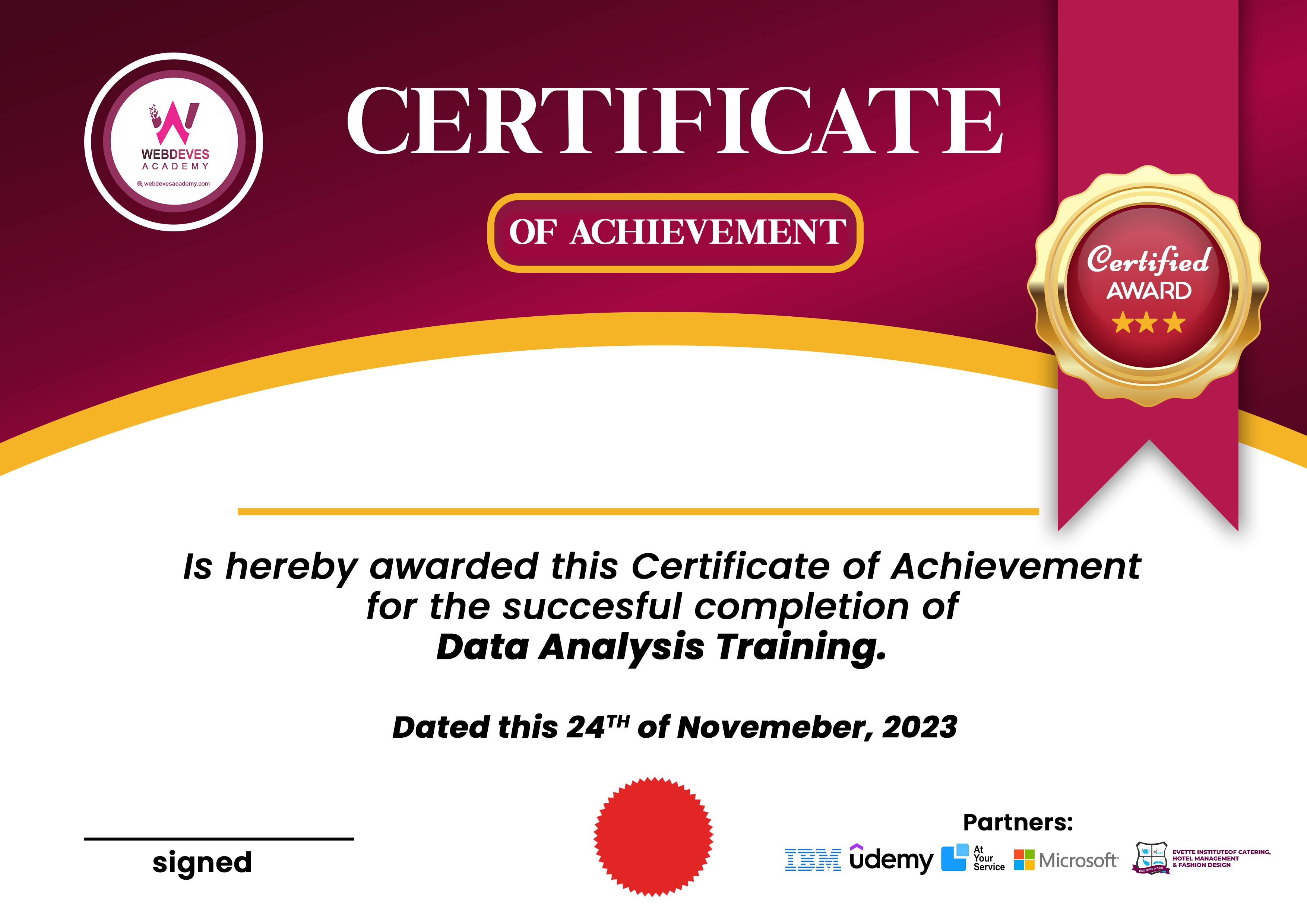
Yes, upon successful completion of the course, you will receive a certificate from Webdeves Academy indicating that you have completed the Data Analysis course. This certificate will serve as a valuable addition to your resume and can help you stand out in a competitive job market.
Industries such as finance, healthcare, marketing, and e-commerce benefit from data analysis by making data-driven decisions, improving operations, and understanding customer behavior.

Limited Seats Available
Looking to gain the skills and knowledge needed to excel in Data Analysis? Look no further than Webdeves's Data Analysis course!
Our comprehensive program is designed to equip you with the skills and knowledge needed to excel in the field of data analysis. Whether you're just starting your career or looking to enhance your existing skills, this course is perfect for you.
Our course covers a wide range of topics.
Need Further Information - Just Write to Us
Related Courses
On-Demand skills that you might be interested in.

Full Stack Web Development
The course is tailored for individuals interested in pursuing a career in Full Stack Web Development, as well as professionals looking to upskill in this field. Students will be introduced to various Full Stack Web Development tools and techniques, including data mining, statistical analysis, and machine learning.
Project Management
The course covers various project management methodologies, including Agile, Scrum, and Waterfall, and includes practical exercises to help learners apply their knowledge in real-world scenarios.



Miracle, Data Analyst
The data analysis course was exactly what I was looking for. The instructors were knowledgeable, and the course content was comprehensive. I learned a lot and feel more confident in my ability to work with data.